Elon Musk Got It Wrong, or Is This His Clever Move
The simulation hypothesis, who gets to be responsible, and how Formula 1 stopped treating driver deaths as normal.
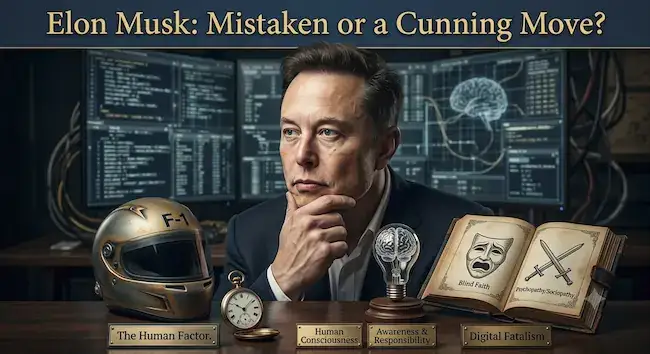
Since 2016 Musk has been repeating the same idea: we are most likely living in a simulation. His main argument is the speed of progress. Forty years ago there was Pong, a primitive game with two paddles and a dot, and today photorealistic worlds are being built. He suggests that if this trend holds, technology will eventually allow billions of simulations to be created, with intelligent beings generated inside them. And since there will be billions of virtual worlds and their inhabitants while reality is only one, the mathematical chance of finding yourself in reality rather than in a simulation is one in a billion.
On Joe Rogan's podcast Musk added: why would you make a boring simulation, you would make one that is more interesting than base reality. In 2025 he wrote on X that boring simulations get switched off to save compute, the way we do with our own. His long-standing formula belongs to the same series: the most entertaining outcome is the most likely one.
Out of this comes a picture that people are eager to pick up. Wars, deceptions, catastrophes are not accidents and not anyone's fault, but part of the design. The creator needs drama the way a viewer needs a plot.
Arguing with the simulation hypothesis itself would be a mistake. It may well turn out to be true, nobody knows, and Musk does not know either. What raises doubts is what gets derived from it.
Who the Creator Is in This Hypothesis
The word “matrix” is misleading, because it drags along the image of a deity. In the original version there is no deity at all.
The argument was formulated by the philosopher Nick Bostrom in his 2003 paper “Are You Living in a Computer Simulation?”. It is about ancestor simulations: a civilization that reaches a very high technological level computes its own past or variations of it. The creator in this scheme is neither omnipotent nor omniscient. These are ordinary intelligent beings, possibly our own descendants, who happen to have a great deal of computing power. They are limited by a compute budget, they can shut the process down, and they may themselves be inside someone else's simulation.
What Bostrom actually concludes matters too. His conclusion is not “we are in a simulation” but a fork: at least one of three things is true.
- Either civilizations almost always die out before reaching the required level.
- Or they reach it, but almost nobody runs such simulations.
- Or we really are inside one of them.
You cannot pick the third option and declare it the only one, that does not follow from the argument. Yet this is exactly what Musk does.
There is a second problem, a purely technical one. The path from Pong to photorealism is progress in rendering a picture. The simulation being discussed requires reproducing consciousness, not an image. These are different tasks, and success in the first says nothing about the second. Musk offers evidence for a claim other than the one he is defending.
A Simulation Does Not Imply a Script
Even if we are inside a simulation, it does not follow that what happens is predetermined.
A simulation is run precisely when the outcome is unknown. That is the whole point: if the result were known in advance, there would be no reason to run it, you could just look up the answer. So there is no ready-made plot. There is a run in which the participants really do decide for themselves, and their decisions really do change the result.
And what about the drama the creator supposedly needs? Nothing whatsoever is known about the creator's motive. It does not follow from the simulation hypothesis in either direction: neither “he needs a war” nor “he is looking for a good outcome”. Any statement about what the creator wants is something a person takes from themselves.
In fact the question is not about how the world is built, but rather about the speaker. Musk said that the interesting beats the boring and that suffering is part of the show. That is his picture of the world, not a property of reality. Whoever looks at human history and first of all sees a script with dramaturgy is reporting on themselves, not on the creator.
Hence the question in the title. I will not claim that Musk says this calculatedly. But such a frame has a side effect regardless of intent: it removes responsibility. If cruelty is built into the design, nobody in particular answers for it. Neither the one who produces it, nor the one who does nothing to stop it.
What Formula 1 Showed
The claim that “this is how life works and nothing can be done” is easiest to question with a concrete example. It is enough to look at a field that thought exactly that for a long time, and then went and changed everything.
In the sixties, drivers dying was considered an inseparable part of motorsport. Not unfortunate statistics, but the norm. In 1968 Jim Clark, Mike Spence, Ludovico Scarfiotti and Jo Schlesser were killed, and that was in a single season.
What matters is that the situation held not because there was no other way, but because nobody had been made responsible. Offer a driver a car that is faster and more dangerous or slower and safer, and he will choose the first: he is fighting for a win, not for his own preservation. For circuit organizers, safety cost money and returned nothing. In 1968 at Brands Hatch they refused to remove the trees along the track or even to put barriers around them, explaining that the trees were small. Three months earlier Jim Clark had died hitting exactly such a small tree.
One person started the turn. In 1966 Jackie Stewart went off the track at Spa and lay for about twenty-five minutes in an overturned car soaked in fuel, with no doctors and no tool to get him out. Other drivers freed him with a screwdriver borrowed from spectators. After that he began demanding barriers, a medical service at the circuit, fireproof gear. He was called a coward and a mummy's boy, and accused of ruining racing. He was a world champion, and even so it took years.
What worked next was not persuasion but a rule. Responsibility for safety was shifted from the person taking the risk onto the organizer and the regulations. After 1994, when Roland Ratzenberger and Ayrton Senna died on the same weekend at Imola, the FIA turned this into strict mandatory standards, and every major accident began to be investigated and converted into a change in the rules.
The result is known. It would not be right to say deaths are gone: Jules Bianchi crashed at Suzuka in October 2014 and died in July 2015. But what used to be the norm of a season became an event that is examined for years.
The lesson of this story is not that people became kinder. The priority shifted when being unsafe stopped being profitable.
Why Confidence Wins
So why do ideas like this spread at all?
People tend to take at face value those who speak without a shadow of doubt or who hold some authority in a field. This is of course neither stupidity nor a vice, it is plain economy of effort: someone else's confidence is used as a sign of competence, because checking takes time and a decision is needed now. The failure happens when this mechanism fires on empty confidence backed by nothing.
From there it goes as in motorsport before Stewart. A loud statement pays off immediately, and the reckoning for being wrong almost never arrives. Being carefully right brings nothing. As long as this arrangement holds, confidence will keep winning, and no appeals to think critically will change it, because the appeals are addressed to the one taking the risk, not to the one setting the rules.
Saying “we need to shift the focus of priorities” would be exactly the same contentless confidence this whole text argues against. So I will put it more honestly: I have no ready mechanism, but it is clear where to look for one. In Formula 1 what worked was the memory of every accident and a mandatory investigation. The analogue for public rhetoric is a memory of predictions: who claimed what, how it ended, and whether that is visible next to the new claim. Such prediction registries exist, they simply do not influence anything yet.
How far this applies to a person with hundreds of millions of followers, I do not know. But in the sixties it also seemed that drivers would always keep dying.