Movies About Creative Thinking: A change of viewpoint
Films where nothing changes except the way of looking, and that turns out to be enough.
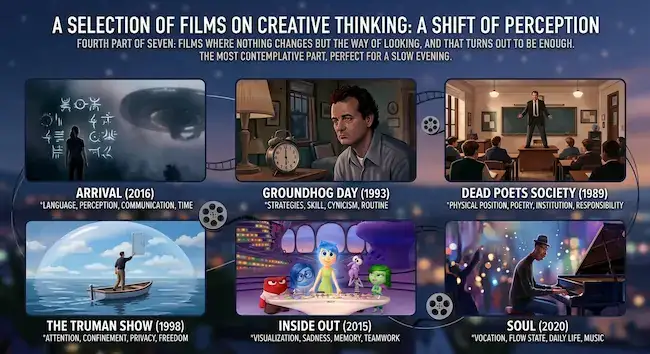
Part four of seven. Films where nothing changes except the way of looking, and that turns out to be enough.
The most contemplative part of the selection; it goes well in an unhurried evening.
Arrival (2016)
A linguist decodes the language of the visitors and gradually begins to think in its categories.
Language as a frame of perception, communication without shared context, trust between countries under uncertainty, the perception of time.
Aftertaste: quiet, meditative, emotionally stunning at the end. A film that keeps unfolding in your head for days and almost always demands a rewatch.
Groundhog Day (1993)
A TV reporter gets stuck in a single day and lives it again an unlimited number of times.
Cycling through strategies and discarding the ones that do not work, acquiring a skill through repetition, cynicism and its wear, the meaning of routine.
Aftertaste: funny and unexpectedly wise. A comedy that turns out to be nothing like a comedy when you rewatch it as an adult, and that feeling is a pleasant one.
Dead Poets Society (1989)
A literature teacher at a conservative school makes his students stand on their desks to look at the classroom from a different height.
A change of physical position as a change of thinking, poetry against the manual, pressure from family and institution, the responsibility of the one who inspires.
Aftertaste: first the lift, then the weight, and the whole power of the film lies in that shift. One of those things remembered for years by a single scene.
The Truman Show (1998)
A man lives his life inside a set and gradually starts noticing the inconsistencies.
Attention to small anomalies, the boundaries of a familiar environment, privacy and spectacle, freedom as the decision to walk out.
Aftertaste: deceptively light, slightly unsettling, with a very strong ending. A comedy that reads more seriously with every passing year.
Inside Out (2015)
A girl's emotions are shown as a team of operators at a console, each with its own function.
Visualising the invisible, the role of sadness in the psyche, memory and growing up, a team working with incompatible priorities.
Aftertaste: tender and tearful. An animated film that makes adults cry more often than children, and they still leave in a good mood.
Soul (2020)
A jazz pianist spends his whole life waiting for his big gig and gets a chance to look at that story from the outside.
A calling and the idea of a calling, the state of flow, the value of an ordinary day, music as a way of being present.
Aftertaste: calming and slightly melancholy. Good to put on right after Whiplash; the two films end up arguing about the same thing.