Cybersecurity Books: Fiction
Novels where the technology is described accurately enough that a professional does not wince, and which set the language of the industry.
Part nine, the last one. Novels where the technology is described accurately enough that a professional does not wince.
There is less here that is useful for the job than in the other eight parts, but these books set the language the industry uses to talk about itself.
Neal Stephenson. Cryptonomicon (1999)
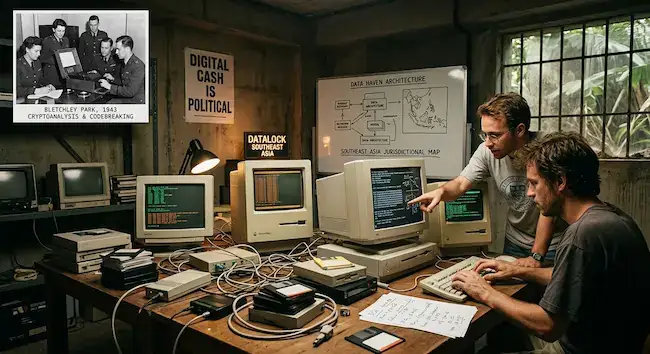
Two threads: cryptanalysts of the Second World War and programmers of the nineties building a data haven in Southeast Asia. The text contains a working cipher and detailed explanations of the mathematics.
Cryptanalysis and the leak created by the very fact of decryption, digital money before bitcoin, jurisdiction and data storage, privacy as a political position.
William Gibson. Neuromancer (1984)
The novel that coined the word "cyberspace" and most of the genre's visual vocabulary. Technically it resembles nothing in particular; its influence is enormous.
Breaking into corporate systems, artificial intelligence and the limits placed on its freedom, mercenaries in a digital economy, the body and data.
Neal Stephenson. Snow Crash (1992)
A virus that runs in a computer and in the human brain at the same time. This is where the word "avatar" in its modern sense comes from.
Malicious code and how it spreads, the metaverse thirty years before the current wave, the privatisation of infrastructure, language as a vulnerability.
Daniel Suarez. Daemon (2006) and Freedom (2010)
A dead game developer leaves behind a program that, after his death, starts hiring people and rebuilding the economy. The author worked as a systems consultant himself, and it shows.
Autonomous systems with no operator, poisoning decision-making processes, compromising industrial facilities, distributed organisations with no centre, botnets as a workforce.
Cory Doctorow. Little Brother (2008)
Teenagers in San Francisco fall under total surveillance after a terrorist attack and build a network of their own. A novel and a primer on basic digital hygiene at the same time.
Public key cryptography explained plainly, webs of trust, poisoning mass surveillance systems with noise, anonymity networks, false positives as a political instrument.
Mark Russinovich. Zero Day (2011)
The author of Sysinternals and CTO of Azure wrote a techno-thriller about a coordinated attack on infrastructure. The technical part here is more accurate than in professional novelists' work.
Malicious code in critical systems, logic bombs, responding to a mass incident, industry's dependence on a handful of software vendors.
Jeffery Deaver. The Blue Nowhere (2001)
A crime novel about a social engineer who uses access to other people's systems to stalk his victims physically. The author was advised by working practitioners.
Social engineering, a remote access trojan, the digital trail and surveillance of one specific person, how an investigation handles computer evidence.
Neal Stephenson. Reamde (2011)
A ransomware program infects a game universe, and the virtual conflict spills into the real world fairly quickly.
Extortion and ransom, laundering money through a game economy, dealing with criminal groups over the network, the boundary between virtual and physical damage.
That is the end of the series.
The whole series: