Cybersecurity Movies: Based on True Events
Films with a primary source behind them: a court case, an investigation, or a memoir written by a participant.
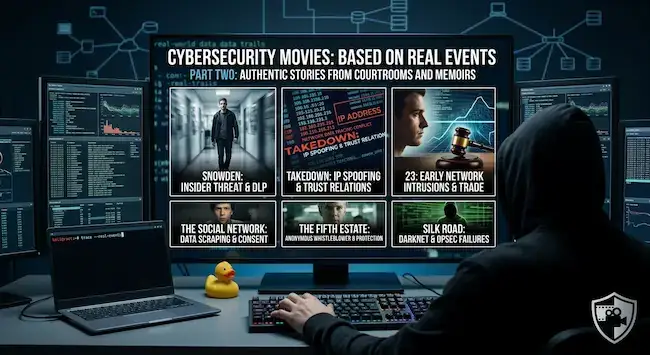
Part two of six. Films with a primary source behind them: a court case, a journalistic investigation, or a memoir written by a participant. They take dramatic liberties, but the attack itself is taken from life.
What makes them useful is the post-mortem: you can almost always see the one decision after which everything went wrong.
Snowden (2016)
The story of a contractor with maximum access rights who walks material out of a closed environment because he decides it should be out there.
Insider threat under legitimate access, mass collection systems and metadata analysis, exfiltration on removable media around DLP, protecting a source while handing over material, the difference between the right to read and the right to copy.
Takedown (2000)
A dramatization of the standoff between Kevin Mitnick and Tsutomu Shimomura. It was adapted from a book written by one of the parties, so its portrait of the people is one-sided, but the technical side is recognizable.
IP spoofing, TCP sequence number prediction, host trust relationships as an attack vector, calls to support desks impersonating an employee, digital forensics and cellular tracking.
23 (1998)
Germany in the eighties, the Chaos Computer Club, and a young man who reaches academic and military networks from a home terminal and then sells the access. Some of the people involved publicly disputed the film's accuracy, so comparing the versions is as interesting as the film itself.
Early network intrusions over X.25 and weak accounts, lateral movement between connected networks, trading access, and operational security degrading over time.
The Fifth Estate (2013)
About a platform for anonymous publication and the people who built it: how to accept material without knowing the sender, and what to do with the volume.
Anonymous document submission, source protection, redacting sensitive data before publication, distributed infrastructure and mirrors, the conflict between total transparency and the safety of specific people.
Silk Road (2021)
A darknet marketplace and the investigation around it. Nobody broke the cryptography in this story.
Tor and hidden services, cryptocurrency payments and transaction chain analysis, deanonymization through old public posts and reused nicknames, operational security mistakes, undercover work inside the team.
Next part: genre classics.
The whole series:



































The Social Network (2010)
How a student project collects data nobody gave it, and what follows from that.
Scraping restricted resources, weak authentication in university systems, processing personal data without consent, disputes over ownership of code and product, the reputational fallout of a leak.