Cybersecurity Movies: Genre Classics
The films that set the language the industry still uses when it talks to the public about hacking.
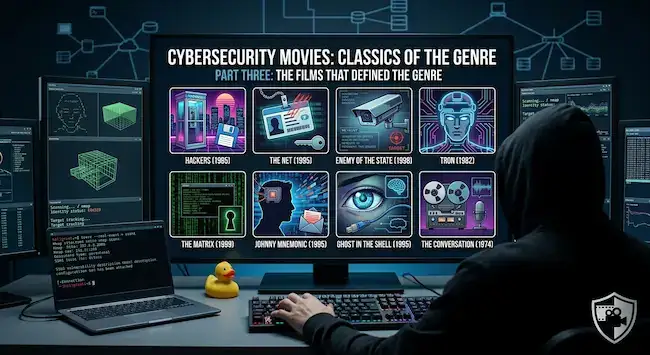
Part three of six. These films matter because they set the language the industry still uses when it talks to the public. Half the stereotypes about hackers come from here.
Watch them with an allowance for the year they came out: they got more right than it seems.
Hackers (1995)
A file system rendered as a three-dimensional city, rollerblades, modem speed as a point of pride. Behind the visual nonsense sits a set of techniques that still work.
Dumpster diving, calling the guard while impersonating management, shoulder surfing a password, the list of most common passwords, a virus inside a corporate network, framing an employee to cover up theft.
The Net (1995)
An analyst has her identity erased: records in databases are changed, and the person is left with no documents, no accounts, and no biography.
Digital identity theft, trust in centralized registries, supply chain compromise through widely used software, a backdoor inside a security product, offline life depending on online records.
Enemy of the State (1998)
An ordinary man accidentally receives a file and discovers that he can be watched around the clock.
Total surveillance and metadata, tracking through devices and radio tags, phone compromise, working with cameras and satellite data, breaking away from surveillance.
Tron (1982)
The first serious attempt to show what happens inside a system, and also the first film about a corporation that appropriated someone else's code.
Access control and administrator privileges, a monitoring program that starts running everything else, intellectual property theft, system access from inside the physical perimeter.
The Matrix (1999)
The cultural foundation of the entire genre. The sequel deserves a separate mention, Reloaded (2003): it shows a real nmap and an SSH1 exploit that was genuine at the time, with a correct root password change after login.
Port scanning and reconnaissance, exploiting a known service vulnerability, privilege escalation, attacking a control system through a physical piece of infrastructure.
Johnny Mnemonic (1995)
A courier carries data in implanted storage inside his own head. The idea that information is cargo people will kill for is taken here to its literal conclusion.
A physical data channel that bypasses networks, encryption with a split key, capacity limits and media integrity, corporate suppression of information.
Ghost in the Shell (1995)
An anime about a unit that investigates crime in a world where people themselves are connected to the network.
Hacking cybernetic prosthetics and implants, memory tampering, false data from a trusted source, spoofing sight and hearing, attack attribution when the operator is fully anonymous, the security of human-machine interfaces.
The Conversation (1974)
The earliest film in the selection. A surveillance specialist violates other people's privacy for a living and guards his own with paranoia.
Signal interception and recovery, reconstructing a recording from several sources, the surveillance operator's own security, the risk of misreading intercepted data.
Next part: mainstream cinema.
The whole series: