Cybersecurity Movies: Mainstream Cinema
Blockbusters where security drives the plot, and individual scenes are useful as examples of what never happens.
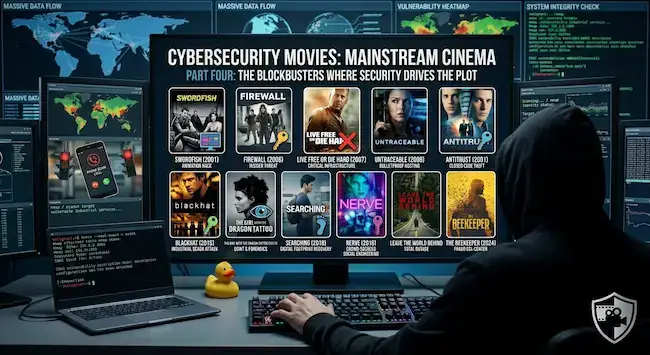
Part four of six. Blockbusters and genre cinema where security drives the plot. Do not expect technical accuracy here, but the threats it picks are the right ones, and some scenes are useful precisely as examples of what never happens.
Swordfish (2001)
A break-in in sixty seconds under pressure, with six monitors and animation instead of code. The canonical example of movie nonsense, worth watching to see where clients get their expectations from.
Recruiting a specialist under coercion, laundering and moving money through transfers, an attack on banking infrastructure, false flag operations.
Firewall (2006)
A bank security specialist is forced to bypass the system he built himself.
An insider under duress, abuse of legitimate access rights, bypassing separation of duties and the four-eyes rule, data theft through improvised media, blackmail as an attack vector against a person.
Live Free or Die Hard (2007)
A scenario of taking down critical infrastructure one layer at a time: transport, finance, communications, power.
Attacks on industrial control systems, traffic lights and power grids as targets, disposing of the people who wrote the code, panic and loss of communications as a damage multiplier, a city depending on a handful of control centers.
Untraceable (2008)
The FBI tries to take down a website and discovers that simply switching it off is not possible.
Bulletproof hosting and constant platform hopping, mirrors and distributed infrastructure, traffic-based tracking, cross-border jurisdiction, an audience whose attention amplifies the attack.
Antitrust (2001)
A corporation assembles its product out of code written by independent developers. The era when open source was a political position.
Employee surveillance, intellectual property theft, covert data exfiltration from an office, access to developers' personal machines, security inside a company's trusted perimeter.
Blackhat (2015)
An attack on an industrial controller causes an accident at a real facility. The premise is honest and clearly inspired by Stuxnet, but the execution is naive in places.
Attacks on industrial controllers and SCADA, malicious code inside a closed environment, a keylogger and targeted phishing of an employee, market manipulation through an engineered accident, an international incident investigation.
The Girl with the Dragon Tattoo (2011)
The best portrayal of a security researcher in the mainstream: the character works carefully, documents everything, and does not show off.
OSINT and archive work, physical access to someone else's machine, installing remote access tooling, data recovery and digital forensics, using collected material as leverage.
Searching (2018)
The whole film is shown through device screens. A father reconstructs his daughter's life from her accounts.
The digital footprint and what it says about a person, recovering access to someone else's accounts through email and password resets, password reuse, browser history and geolocation as data sources, the risks of open profiles.
Nerve (2016)
An online game of dares with an audience and challenges that keep getting more expensive.
Gamified engagement, collecting personal data at sign-up, access to accounts and transfers inside the platform, deanonymization of participants, the crowd as a pressure tool, voluntarily giving up privacy for status.
Leave the World Behind (2023)
A large-scale outage seen by people who do not understand what is happening and have nobody to ask. Directed by Sam Esmail, the creator of Mr. Robot.
Simultaneous failure of communications, transport and broadcasting, poisoning of the information space, how prepared ordinary people are for a long outage, the absence of backup channels.
The Beekeeper (2024)
Absurd action around a thoroughly non-absurd problem: industrial-scale call centers that rob elderly people.
Phone fraud as a well-run business process, fake virus warnings and remote access to the victim's computer, databases of vulnerable people, cashing out the proceeds, the helplessness of an ordinary user against an operator's script.
Next part: documentaries.
The whole series: