Electricity in Simple Words
A simple explanation of electricity through bicycles, water pressure, and an old sewing machine.
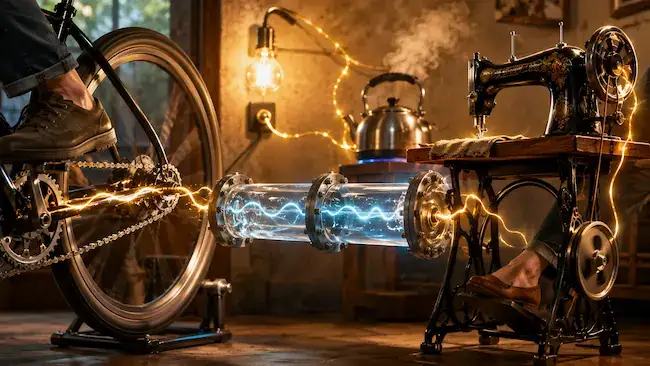
Electricity is often explained with correct words: voltage, current, electrons, field, resistance.
The problem is that correct words do not always create a clear mental picture.
A person can know the definitions, remember the formulas, understand circuits, and still feel that the explanation remains too dry. Especially when the goal is to explain it to someone without a technical background.
I think electricity is easiest to understand through mechanical analogies.
Direct current is like a bicycle
Imagine a bicycle.
A person presses the pedal with their foot. The pedal transfers force to the chain. The chain transfers force to the wheel. The wheel turns.
In this picture, the important part is not the pedal itself or the chain itself, but the transfer of force.
A person creates pressure in one place, and the work happens somewhere else.
Direct current can be imagined in a similar way.
An energy source, such as a battery, creates electrical pressure. This pressure acts on free electrons in the wire. The electrons begin to shift slightly in one direction. A device receives energy and turns it into something useful.
- A light bulb turns it into light.
- A kettle turns it into heat.
- A motor turns it into motion.
- A phone charger turns it into battery energy.
The important point is that the wire already contains free electrons. They do not need to be delivered from the battery to the light bulb like a package. The system is already filled with something that can move.
Just like a bicycle chain is already in place and ready to transfer force.
Water helps explain the speed of transfer
Now imagine a pipe completely filled with water.
If pressure is created at one end, the water at the other end starts to respond almost immediately. This does not mean that one specific water molecule instantly crossed the whole pipe. The pressure was simply transferred through a filled system.
Electricity works in a similar way.
Electrons in a wire do not move as fast as people often imagine. But the electrical effect spreads through the circuit very quickly.
That is why a light bulb turns on almost immediately.
Not because an electron from the power station reached your apartment. It happens because the conducting system is already filled with charges, and the effect is transferred quickly through the whole circuit.
Alternating current is like an old sewing machine
Now imagine another picture.
An old mechanical sewing machine with a foot pedal.
A person presses with the toe, then with the heel. The pedal moves back and forth. Through a belt, this movement is transferred further, and the machine works.
The movement does not go in one direction all the time.
- Pressed with the toe.
- Pressed with the heel.
- Again with the toe.
- Again with the heel.
But energy is transferred. The mechanism comes alive.
This is a good everyday analogy for alternating current.
In a wall outlet, electrons do not fly in one long stream from the power station to your kettle. They mostly oscillate back and forth inside the wires.
A power station creates an alternating electrical effect. This effect constantly changes direction. Charges in the conductor respond to it, and energy is transferred further.
- The kettle heats up.
- The light bulb shines.
- The motor works.
Even though the charges move back and forth.
What the power station actually does
A power station does not send its own electrons into a house.
It creates an electrical effect in a large connected system. This effect travels through the grid to your device. The electrons that take part in the work are already inside the wires.
Returning to the analogies:
- in a bicycle, force is transferred through the chain;
- in a pipe, pressure is transferred through water;
- in a sewing machine, the pedal movement is transferred through a belt;
- in an electrical circuit, the effect is transferred through the electric field and the charges in the conductor.
Physics is more complex than any analogy, but this is enough for a first clear picture.
The shortest picture
A wire is not an empty channel.
It already contains free electrons.
- Voltage is electrical pressure.
- Current is the response of charges to that pressure.
- Resistance is what makes movement harder and turns part of the energy into heat.
- A device takes the energy and turns it into light, heat, motion, or battery charge.
Direct current is like a bicycle: force is transferred in one direction.
Alternating current is like an old sewing machine: movement back and forth can also transfer energy and make a mechanism work.
See it move
The same chain, but interactive: one slider drives the river, the turbine, the magnet, the electrons in the wires and the pump at the far end.
Where electricity comes from: interactive diagram