Why SEO Is Still Alive
Generated answers did not remove the pipeline underneath them. What actually changed in search, what did not, and where the traffic really went.
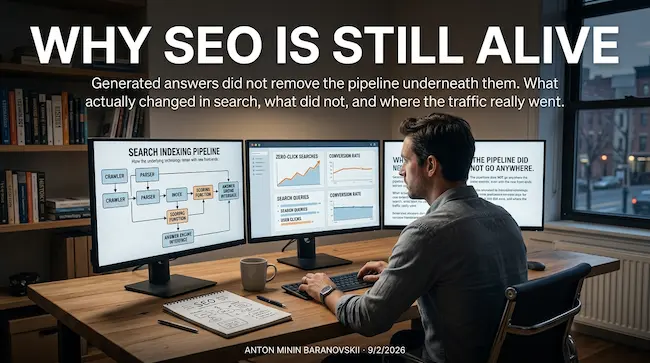
Every eighteen months somebody announces the death of SEO, and the obituary is always written from the same observation: people ask a chatbot instead of typing a query into a box. The observation is correct. The conclusion drawn from it is not.
An answer engine is not an alternative to search. It is a client of search. The moment a model has to say anything about the world after its training cut-off, it runs a retrieval step first, and that retrieval step runs against an index built by a crawler that reads HTML off your server. The interface changed. The plumbing did not.
So the useful question is not whether SEO survives. It is which parts of it were always cargo cult and which parts were load-bearing.
What actually changed
Three things moved, and they moved for real. Pretending otherwise is how you end up defending a practice that stopped working.
- The zero-click share grew. A large part of informational queries is now answered on the results page or inside a chat window and never becomes a visit.
- The entry point fragmented. A query is no longer one box. It is a box, a voice assistant, an assistant inside somebody else's app, and a model with browsing turned on.
- The unit of competition got smaller. You used to compete with a page. Now a passage of your page competes with a passage of somebody else's page, and the rest of your document is not in the room.
Not one of those three removes the crawler, the index, or the scoring function. They change who reads the output and how much of it is shown.
What did not change
The pipeline. A page still has to be fetched, parsed, torn into terms or embedded into vectors, scored against something, and selected over its neighbours. Every one of those steps is gated by the same unglamorous properties it was gated by ten years ago.
- Reachable without a login and without executing a megabyte of JavaScript first;
- One stable URL per subject, not four near-duplicates competing with each other;
- A heading tree that matches the actual structure of the text;
- Facts written as plain sentences, with dates, instead of implied by a chart image;
- A server that answers before the crawler loses patience.
This is what people usually mean when they say SEO is dead. They mean the keyword-stuffing era is dead. That era has been dead for a decade, and its funeral keeps getting re-announced by people who never attended the first one.
The half nobody writes obituaries for
Informational queries are the ones being eaten. Commercial ones are not. Somebody comparing prices, checking whether a thing is in stock, looking for a supplier in their own city, reading terms before signing: that person still ends up on a page, because the transaction lives on the page and nowhere else.
Which means the traffic a generated answer removes is largely the traffic that was never going to convert. Losing "what is X" and keeping "X supplier in Y" is not a catastrophe. For a lot of businesses it is a cleaner funnel with a worse-looking chart.
The chart went down and the revenue did not. Those are two different events, even though the dashboard shows them in the same rectangle.
The honest version of the worry is different and worth stating: if the informational layer stops sending visits, the incentive to write it thins out, and the corpus the answer engines are reading gets worse. That is a real problem. It is a problem about who pays for the writing, not about whether the index still exists.
What to actually do
- Fix the crawl before touching anything else. A page nobody fetched cannot rank badly, it is simply absent, and no amount of content work moves it.
- Give each page one question to answer. Two subjects on one URL means two mediocre matches instead of one good one.
- State facts as sentences, with numbers and dates in the text. Anything living only in an image or a script is invisible to half the pipeline.
- Keep the heading tree honest. It is the cheapest structural signal you can give, and it is the same signal a chunker uses later.
- Measure impressions and presence in answers, not only sessions. If you judge the work by clicks alone you will delete the pages that are doing the most for you.
Every item on that list is also the entry ticket for generative engines. That is not a coincidence, it is the whole argument of this series, and the next two parts take it apart.
See it move
The same pipeline, interactive: one slider drives the crawler, the inverted index, the query, the scoring function and the curve that decides how much of the attention reaches position five.
How a search engine decides who gets found: interactive diagram