Connectors Melt on Nvidia, Gigabyte and Sapphire, and You Get the Blame
Three generations of cards, different vendors, one failure pattern: 12VHPWR and 12V-2x6 examined through physics, safety standards and warranty terms.
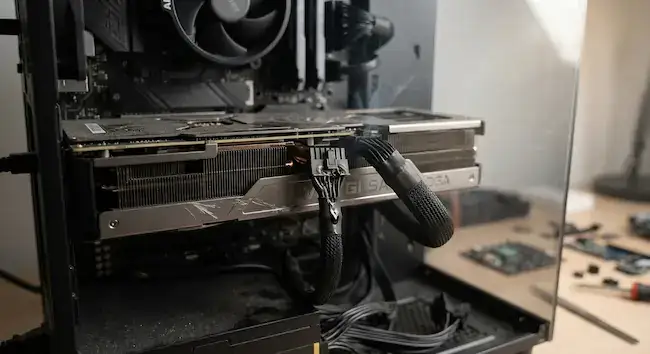
I have been building computers for about as long as I have been able to hold a screwdriver. Dozens of graphics cards, memory sticks, coolers, power supplies. Seating a card in its slot and plugging power into it long ago became one of those actions you perform without thinking: push it in, hear the click, close the case. Roughly like screwing in a light bulb.
That is exactly why the story of the sixteen-pin power connectors caught my attention. Not because the physics is complicated (the physics is in fact simple), but because a product reached the mass market whose safety depends on performing a household action flawlessly, while the explanation offered for failures is that the buyer did something wrong.
A note on genre up front. What follows is an engineering and legal analysis, not a fact established in court. No court in any jurisdiction has so far found these cards defective in design, and I will not claim otherwise. Everything factual is backed by links in the text, everything evaluative is marked as an assessment.
What Is Really Happening
A lot of folklore has grown around this topic. People write that the card catches fire if you insert the connector at an angle, quote fractions of a degree, describe the case bursting into flames instantly. That is not true, and starting an analysis with exaggerations is counterproductive: the first person with a datasheet will shut the argument down.
The specification contains no requirement for angular precision during installation. There are two real conditions: the connector must be fully seated, and the cable must not bend closer than roughly 35 mm from the connector. The typical failure scenario is not a fire either. The typical scenario: the user smells melting plastic, shuts the machine down, opens it up and finds a melted connector on the card, on the power supply, or on both ends of the cable at once. After that the card is usually dead, and so is the power supply.
The problem did not appear yesterday. The first 12VHPWR cases on the RTX 4090 started in November 2022. Northridge Fix, a California repair shop, reported a year and a half after launch that it was receiving up to two hundred damaged 4090s a month. Nvidia then moved to the revised 12V-2x6, and in 2025 the same melting showed up on the RTX 5090 and RTX 5080, Founders Edition included. In February 2026 a case was recorded on a Gigabyte Aorus Master ICE RTX 5090. In June 2026 the bundled adapter from three eight-pin PCIe to 12V-2x6 melted for the owner of a Sapphire Radeon RX 9070 XT NITRO+, that is, on a card with an AMD chip and the same connector.
Three generations, different board makers, different GPU designers, one failure pattern. For an engineering analysis this is the single most important fact: if a failure survives a change of standard revision, a change of board vendor and a change of chip vendor, looking for its cause in the user's hands is odd.
The Physics: Where the Margin Went
The classic eight-pin PCIe connector is rated for 150 W, and the current capacity of its contacts exceeds that figure several times over. The standard did not change for twenty years, and not by accident.
The new connector delivers 600 W through six power contacts. By specification each contact must withstand 9.2 A at a connector temperature rise of 30 degrees above ambient. The RTX 5090 draws 575 W at peak. In other words, the nominal load nearly hits the connector's rated limit: a margin of about ten percent instead of the usual multiple.
On its own this is not yet a disaster. It becomes one in combination with a second decision.
Where the Control Went
On the RTX 3090 Ti the six twelve-volt wires did not arrive at the board as a single bundle. They were split into three groups, each with its own shunt resistor, feeding a separate bank of power phases. The card could see the current in each group and balance the load. No single wire could take on a disproportionately large share of the current. History records almost no RTX 3090 Ti cards with melted connectors, even though the connector was the same one and power draw was close to the 4090.
The RTX 4090, and especially the RTX 5090 Founders Edition, does not have this arrangement. All six lines converge effectively into a single point, and on the 5090 FE board a single shunt remains. The card sees total draw and nothing else. The sense pins tell it the cable is in place, and it calmly pulls its 575 W with no idea how that current is distributed across the wires.
From there it is schoolbook physics: current flows where resistance is lower. If one contact loses a good connection for any reason, its share of the current redistributes onto the neighbours. Their resistance rises with heating, the heating rises with current, and the process turns into positive feedback.
What this looks like in measurements was shown by Roman Hartung, known as der8auer. He took his own water-blocked RTX 5090 FE, a first-party Corsair cable, a Corsair AX1600i power supply, confirmed separately that the connector was fully seated, and applied a FurMark load of roughly 570 W. Within a few minutes one of the wires was carrying over 22 A against a norm of about 5-8 A, with the temperature on the power supply side reaching roughly 150 degrees and about 90 on the card side. This is a single enthusiast test, not a certification procedure, but it was done on a healthy build with the connector correctly inserted, and for that reason alone it cannot be waved away as clumsy hands.
There is no mechanism in the card that would notice such an imbalance and intervene.
Why the User Did Not Push It In Explanation Does Not Add Up
After the RTX 4090 investigation Nvidia stated that the cause was a loose connection causing heating. The company also said it would honour warranties on cards damaged by connector overheating, and put the failure rate at roughly 0.04 percent. According to Tom's Hardware, the investigation covered about fifty cases, and what they had in common was deemed to be an incompletely seated connector.
If that were the complete explanation, the revised 12V-2x6 would have closed the matter. In it the sense pins were made 1.5 mm shorter than the power pins for exactly this reason: if the connector is not fully seated they do not make contact and no power is delivered. Leaving the connector under-seated and still getting a working card became physically harder.
The melting continued.
Two cases are telling, where the owner already knew the connector's reputation and took precautions. The owner of a Gigabyte Aorus Master ICE RTX 5090 lowered the power limit from 575 to 500 W through MSI Afterburner. The connector melted anyway. The owner of a Sapphire RX 9070 XT NITRO+ set a 280 W limit instead of the stock 330 W. The bundled adapter melted.
This means seating quality is not the only variable. Spread in contact resistance also comes from the normal cycle of plugging and unplugging, from the tolerances of the contacts themselves, and from mechanical stress inside a cramped case. A design with neither current margin nor feedback on current distribution turns ordinary manufacturing spread into a failure scenario. That is my assessment, but it matches the conclusions of der8auer and Buildzoid, who examined the board circuitry.
Who Is Fixing It
The most interesting thing to watch is not the statements but what the board makers actually do.
On the ROG Matrix 4090 and ROG Astral 5090, Asus added separate shunt resistors ahead of the point where the lines merge in order to measure current on each wire. On its RTX 50 cards Zotac introduced a Safety Light feature that prevents the card from powering on if the cable is not fully seated.
Tellingly, even the Asus solution can measure the imbalance but cannot remove it. It can neither throttle the card nor shut it down, at most warn the user and suggest reseating the cable, which in itself adds mechanical wear to the connector.
Partners are compensating with circuitry and indicators for what was not solved in the base design. That is usually a fair pointer to where the root of the problem sits.
The Warranty
Nvidia's warranty terms for Founders Edition cards exclude problems not caused by a manufacturing defect or component failure, including those caused by negligence and misuse. The wording is standard for the industry. There is no separate clause about installation contrary to documentation in the GeForce warranty text: that clause exists in Nvidia's warranties for other product lines. So the popular claim that not following the instructions makes it a non-warranty case rests not on the warranty text but on how it is interpreted when a specific claim is reviewed.
Practice is inconsistent, and it is more honest to say so plainly. Nvidia itself publicly promised in 2022 to service affected cards. Refusals come from other levels of the chain. MSI refused to replace an RTX 4090 for an owner who had used a CableMod adapter, citing that adapter's problems and advising the owner to contact its maker; the case only became known after the support correspondence was published. A retailer turned down the owner of a Sapphire RX 9070 XT after forty-eight hours of stress testing and returned the card with its burnt connector, without even replacing the adapter.
Meanwhile a regulator has already spoken on an adjacent product. In February 2024 the US Consumer Product Safety Commission recalled about 25,300 CableMod angled adapters with explicit wording about fire and burn hazards: the connector loosens, overheats and melts in the graphics card's socket. The recall concerns a CableMod product, not Nvidia cards, but it shows that this class of failure has been officially classified as a fire hazard.
What the Argument Is Really About
The term foolproofing is misleading, because it shifts focus onto the user. In engineering this is called poka-yoke: the design must make the wrong action impossible or harmless, not punish you for it.
Equipment safety standards put the idea more sharply. The IEC 62368-1 approach is that equipment is assessed by its energy sources and the consequences of releasing them, and a single fault must not lead to fire or injury. Losing a good contact on one of six power pins is precisely a single fault, and a predictable one that, judging by the volume of repair claims, is not rare.
In law these are two separate categories: design defect and failure to warn. A product is considered defective in design if foreseeable use leads to a dangerous failure and a practically feasible safer alternative existed. The alternative here is not hypothetical: splitting the lines into groups with individual shunts existed on the RTX 3090 Ti and was removed in later generations. The European General Product Safety Regulation 2023/988 and article 7 of the Russian consumer protection law state the requirement in essentially the same way: goods must be safe under ordinary conditions of use, and the duty to ensure that lies with the manufacturer, not the buyer.
The mass market is a distinct circumstance here, not a mitigating detail. Industrial equipment is installed by a certified person, following a procedure, signing off on it. A two-thousand-dollar graphics card is bought and installed by someone who has done this twenty times already and has no reason to expect the twenty-first to be different. In that context the manual stops being a safety measure and becomes a document people read after something has burned.
The argument is not about who is to blame for a particular melted connector. The argument is about whether it is acceptable to sell an end consumer a device that operates nominally within ten percent of its current limit, does not monitor how that current is distributed across the wires, and leaves the buyer's careful hands as the only barrier between normal operation and fire.