Buenos Aires, Argentina
Anton Minin Baranovskii
Engineer, builder of digital products, and author of Thirst for Reality
About
I specialize in building and shipping IT products: from the first business requirements to a service running in production. I can own the full development cycle or join a project at any stage: architecture, systems integration, data security and infrastructure, running AI tooling, and cutting time to market.
Over 10 years in commercial development. Deep expertise in web, mobile and server development, in the architecture of authentication systems, and in designing production ready RAG systems.
I worked at Yandex and Sber: the Yandex Lavka B2B panel, enforcement document processing, utility billing, and a cruise booking service.
Independent since June 2025. My own products and client work: Groundline, Toqen.app, Litseller.com, Start4Drive.com.ar and AutoInspect.
I am the author of Thirst for Reality, a practical guide to solving problems at work and in life: TRIZ, systems thinking, the cognitive behavioral approach, and hypothesis testing.
What I do
Ten years, one career, four practices. The same places (Sber, Yandex, my own products) read four different ways, because the work genuinely was four different things.
-
Lead Full Stack Engineer
Systems that survive growth, a rewrite, and the third change of requirements
-
Security and Identity Engineer
Zero Trust, passwordless, and what happens to a login once the password is gone
-
AI Integration Engineer
LLM pipelines that run unattended and are still right the next morning
-
Technical SEO Engineer
Indexable, fast, and legible to the engines that answer instead of listing
Book
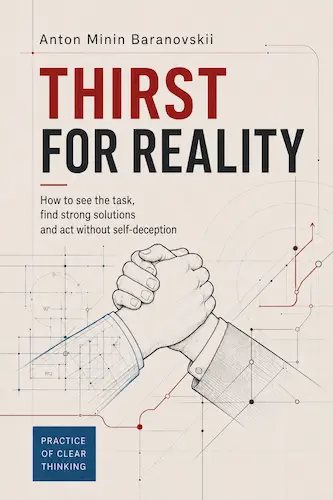
Thirst for Reality
How to see the task, find strong solutions, and act without self-deception
Stop trying to fix yourself and learn to solve problems instead. Or how to make your mistakes work for you. The book gives you a working way to take problems apart: separate facts from interpretations, find the contradiction, see the system, and test the solution with a small experiment. Built on TRIZ, systems thinking, the cognitive behavioral approach, and hypothesis testing.
For people who work on hard problems: founders, engineers, product people, managers, anyone making difficult decisions.
12 chapters, each working through a real task. The conclusion holds a chapter-by-chapter summary and both protocols in full: one for a simple task, one for a complex one.

Experience
- since 2025
Freelance, Argentina · AI Product Engineer
Groundline, Toqen.app, Litseller.com, Start4Drive.com.ar, AutoInspect: architecture, development and launch.
- 2023-2025
Yandex · Full-Stack Developer
The Yandex Lavka B2B panel: reusable UI architecture, microservice integration, onboarding and mentoring.
- 2019-2022
Sber · Chief Software Engineer
An SPA for entering enforcement documents: faster handling, fewer input errors.
- 2018-2019
Cloud Link · Lead Software Engineer
A web application for utility billing systems.
- 2016-2017
Cruise House MK · Frontend Developer
Development and support of a booking service application.
Writing and ideas
Essays on systems thinking, the engineering approach, digital products, and artificial intelligence.
-
The core AI credential problem is solved by removing secrets, not by another attack detector
While the industry argues about AI safety, one of the key layers, handing out access, can already be closed. The access-first infrastructure behind Toqen.app has been running since December 2025.
-
AI Boom 2.0
The first wave of automation receded, the labour market rearranged itself, and it started to feel like a lull. But the point of no return is already behind us, and the next boom is forming right now.
-
Groundline: A RAG Service That Counts the Money It Saves
A pet project on FastAPI and LangGraph: hybrid search, reranking, self-check and a semantic cache that covers 60 to 65 percent of repeated questions. The saving is visible right in the interface.
-
Start4Drive: Road Rules in a Language You Are Still Learning
A driving theory trainer for Argentina where tapping any word in a question shows its translation. What is new: exam mode, express quiz, topics, a mistake bank and a readiness score.
-
A Thirst for Reality: Unpacking GPT-6 Astra
Four numbers from the GPT-6 Astra release: 99.9 versus 62.7, 100 versus 39, 61.2 versus 60.9 and a 2.5x price. Progress has moved into the harness.
Explorable Explanations
Interactive longreads. Pull the sliders, spin the models, and work out for yourself how things actually work.
- Interactive Access in the age of AI
How Toqen.app works
Try to steal the login. On the left a password leaves three things behind for an attacker; on the right there is nothing to take. Pull the slider through the stages and run the attacks yourself.
- Interactive Passing the theory in a country that is not yours
Why twenty minutes a day beats one long night
A single card, forty-five days of calendar, and the algorithm behind Anki reduced to three buttons. Watch what one well-timed review does to the forgetting curve, what a lapse takes away, and why the whole deck becomes cheap only once the intervals have grown.
- Interactive Passing the theory in a country that is not yours
Reading an exam question in a language you are still learning
One real question from the Argentine theory bank, taken apart the way a learner actually meets it. Most of the words can be guessed or skipped. The two that cannot are the entire question, and a full translation hands you the answer while hiding which word carried it.
Series
Longer arcs: an interactive explainer and the writing around it, arranged so one subject builds on the next.
-
Access in the age of AI
3 parts
If there is nothing to steal, there is nothing to defend
The boom is not reversing, and the cheapest way in is still a stolen password. Two pieces and one interactive pull on the same thread: why the next wave is already forming, why the credential layer is the weak one, and what a login looks like when no secret ever leaves the phone.
-
Systems that survive contact with reality
8 parts
Retries, search, merges and the edge of your app
The network drops, the retry duplicates a payment, the search hands the model the wrong passage, the response is not the data you asked for, and two people edit the same line at the same second. Four interactives and the writing on why all of that is the normal case.
-
Passing the theory in a country that is not yours
6 parts
The road rules and the language, learned in one pass
Every country that receives immigrants has the same queue in it: people who have to pass a written driving exam in a language they are still learning. This series follows Start4Drive, a trainer built for exactly that, and the writing around it: what the road rules actually say, and how a product teaches two things at once.
Contact
Write to me to discuss a product, an engineering problem, a consultation, or collaboration. I am also open to conversations about the book: interviews, publications, talks.