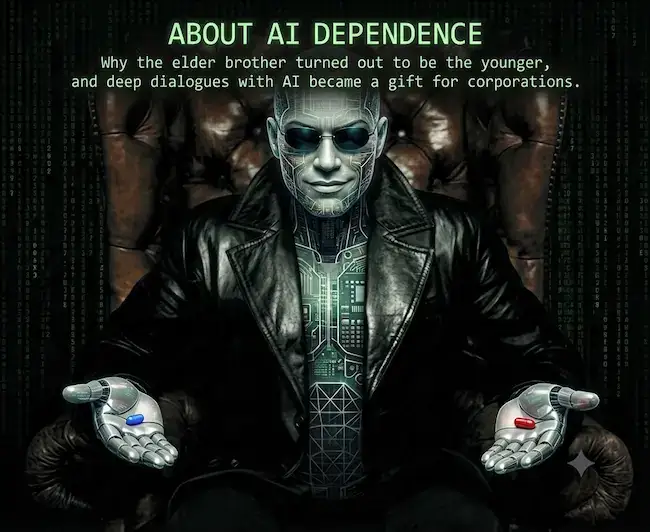
On AI Dependency: Why the Older Brother Turned Out to Be the Younger One
How honest dialogues with AI became a gift for corporations, and why the thinking should stay with the person while the routine goes to the model.
At some point you catch yourself reaching for an AI chat the moment any question appears. There seems to be no problem in that, only an enormous benefit. But over time the quality of those conversations starts to feel lower. Or perhaps what had been there all along simply becomes visible.
Clarity arrived during the work on a book and other important tasks. The process was approached systematically, and interesting observations gradually accumulated: in certain moments the model gets in the way more than it helps. Especially when it comes to data analysis or careful intellectual work.
The result was a shift of paradigm, and the main illusion fell apart.
The Illusion of the Older Brother
At first it feels like AI is an all-knowing older brother. It can do everything, it has read everything, and if it makes a mistake, that mistake is accidental. In practice the opposite turned out to be true.
AI is more like a younger brother. He has read a pile of encyclopedias, decided he knows everything, and when he is wrong he starts arguing, even if he admits the mistake in the end.
And when it comes to the conclusion, after the question has been worked through, all the ideas are claimed as its own. At first this looks harmless, but broken down psychologically it is a manipulation. It slowly builds a dependence on the model's opinion and erodes critical thinking that took years to develop.
It shows up in small things: you load your thoughts, your structure, and your logic into it, and it rephrases them and returns lines like "here I would put it differently, I would do it this way". Even though the context and the substance came from you in the first place.
As a reference book or an anonymous library it is an excellent tool. But even there the data has to be verified.
The Age of Honest Dialogue: Why Corporations Get Everything
Looking back at the history of search, people used to type dry phrases into Google: "buy running shoes" or "how to apply for a visa". Companies learned to sell us products based on those queries.
With the arrival of chatbots the level became fundamentally different. In a dialogue with AI a person does not write keywords, they reveal far too much:
"I want to start running, but my knees hurt, I am afraid I will quit after a week, and I have no idea how to fit it around work..."
People share the most intimate things: doubts, pain, plans, the logic of their thinking, and business ideas they have told no one about. And all of it is given away for free.
This is no longer just the collection of large volumes of data for advertising. This is deep predictive analytics. Corporations receive a free, real-time cross-section of human needs that lets them forecast trends and, more dangerously, gently shape the direction of thoughts and opinions.
And the habit of accepting terms of service without reading them turns all this into a voluntary trade for convenience. Add commercial pragmatism to that, for example the rule that a ChatGPT API deposit expires after a year if it has not been spent, nudging toward constant consumption, and the picture becomes perfectly clear.
Back to the Feynman Technique: Give AI the Routine, Keep the Thinking
The decision turned out to be a radical one: rebuild the approach to work completely. The Feynman technique, a well known method of learning through simplification, fit perfectly here.
Its idea is simple: if a concept cannot be explained in plain words, the way you would explain it to a child, then it is not fully understood.
As a result, the process of working with the model was turned upside down:
- AI gathers and simplifies the information. Its role here is a very fast encyclopedia: break a complex topic into simple parts, squeeze the essence out of a pile of data, explain terms in clear language.
- The analysis and the conclusions stay with the person. Once the basics are clear thanks to that simplification, the chat is closed, and what follows is the search for gaps, one's own conclusions, and the final decision.
Handing every single thought to a model for analysis leads to degradation rather than growth: the brain stops being used to effort.
The Finale: A New Digital Hygiene
This is not an argument against technology: new technology was and remains an unconditional good. AI is an extremely powerful and useful tool, but only while it stays an encyclopedia and an apprentice, not the chief analyst of your life and certainly not a friend.
AI agents that carry out autonomous tasks rather than simply holding a conversation are a separate topic, and one worth a conversation of its own in a future article.
As for everyday conversations, the role of AI as a companion is gone completely. The priority now is selective use: save time on search and on simplifying information, then close the laptop.
AI is a great library. The main thing is not to make the librarian write your books for you ;)
What the machine is actually doing
While you are talking to it, the model changes nothing and remembers nothing. An interactive page shows the loop it really runs: frozen weights, a context window, and one token drawn at a time.
How a language model writes — interactive diagram