While the Tech Elite Plays in the Sandbox, the Job Market Has Become a Meat Grinder
At the top they argue about when AI will break free. At the bottom there are a thousand applicants per job, five roles for one salary, and silence from those who could speak about it.
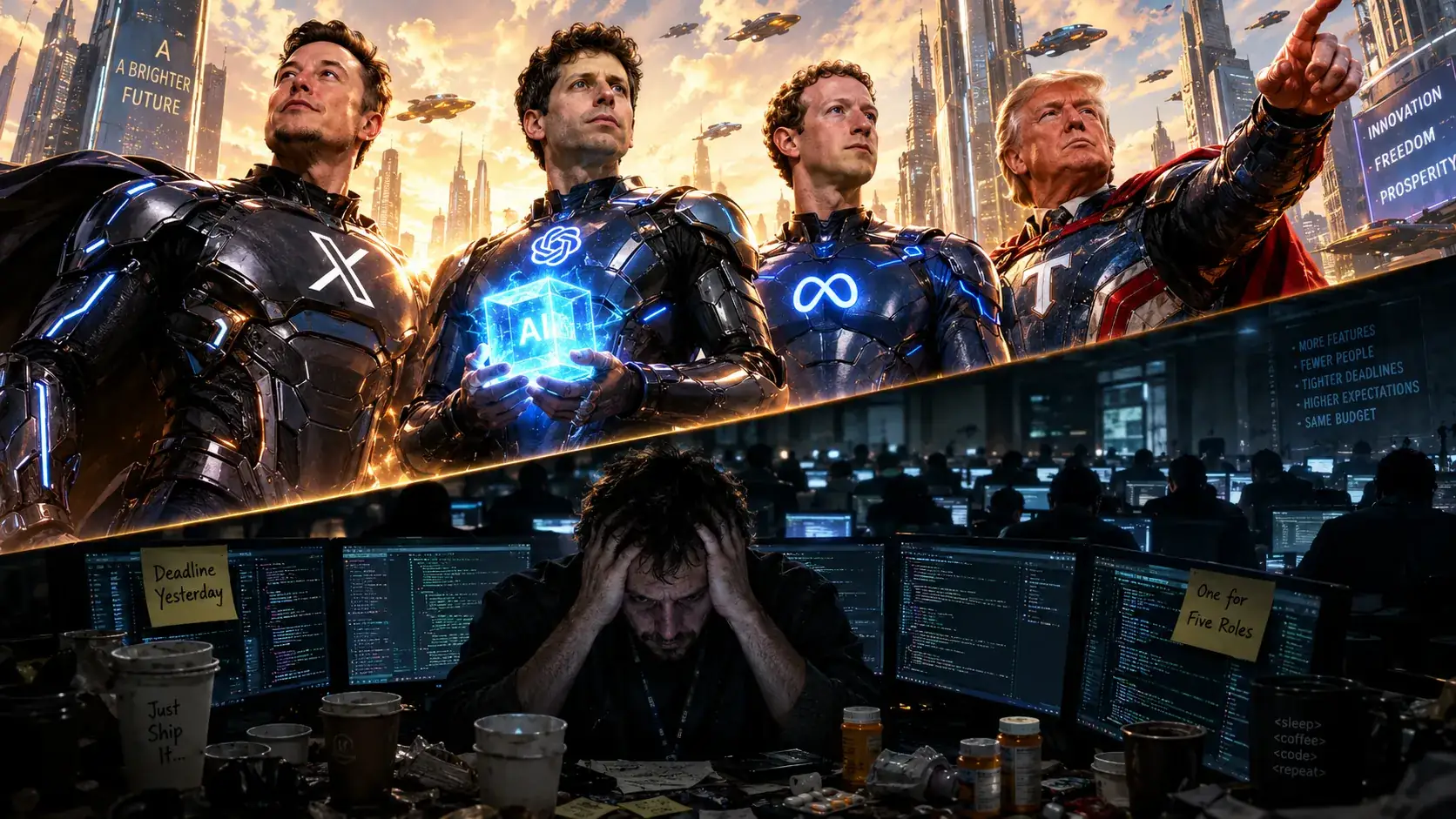
At the top there are endless debates about when artificial intelligence will finally break free and take over the world. I look at what is happening from the job market and see something else: it is already here, and the consequences are visible today. Only they do not strike as terminators from Hollywood films. They strike the professionals who keep this world running. And the whole drama is romanticised with a sauce of inevitability.
And the most repulsive part of this story is the dead silence. Opinion leaders on screens and in cosy podcasts keep talking about a bright tomorrow and existential threats. It is comfortable for them to live in that fairy tale. They do not have to stand in queues of thousands of applicants for a single opening and prove in a live coding session that they were not born yesterday. And we, the specialists, are far from stupid and understand perfectly well what is really going on.
What is happening at the top
While the media are busy with a show to distract us, the picture looks surreal:
- A boy got upset that he was not given a sweet and went to war. Then he started publicly hounding those who would not hand over that sweet. And above all, he lies endlessly: he says one thing, and the next day announces he meant something else entirely.
- A grown man launches little flying cars. Meanwhile people simply have nothing to eat.
- A little creature sits in a cage, and all the experts discuss with a clever look: “Oh, what happens if it escapes? How do we catch it?”
The question is presented as existential. To me it sounds like baby talk. The real systemic crisis is raging somewhere else entirely.
What is happening at the bottom: the reality for programmers and not only them
I have talked to representatives of hundreds of companies as a candidate for a programmer position. Here is the pattern that repeats again and again and makes your hair stand on end:
- A thousand applicants for one position. Hundreds and thousands of CVs arrive for each opening. The employer has gained absolute power: dictate any terms, because the market is flooded with desperate professionals ready to undercut each other.
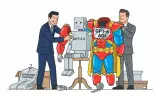
- Five roles in one bottle. One person is expected to deliver a finished product: a system with architecture, reliable authentication, billing, good human-centred design and production quality on the level of a whole team. And all of it in a week. A strong core of five people used to work on a stack like that for half a year. Yes, one programmer with AI gets a lot done, I know that from my own experience. But nearly every area of a system exists for a reason and needs considered decisions by professionals. Infrastructure and a stable release in a week remain a fairy tale for managers who have never written production code by hand.
- Galley rates of a new era. For this amount of work they offer a modest 1,000 to 2,000 dollars a month and an unspoken 24/7 regime. The engineer has to take the client's vague idea and drag it to production alone: product, design, development, infrastructure, tests.
And the really vile part is that some companies build their business on an inflated bubble: while a thousand great specialists tear at each other's throats for a seat, there will always be someone who agrees to work for pennies and without sleep.
Engineering work is craft, not an assembly line
Engineering thought does not live by a template. Every non-trivial task requires designing a solution that consumes cognitive resources, memory and deep attention. An engineer can burn out completely simply because they got absorbed in a hard architectural problem and spent their resource without any outside pressure.
That is exactly why sensible companies have always had sensible conditions: flexibility, a culture of rest, no micromanagement and a focus on results. This is not a whim but a production necessity. A tired brain writes bugs. In distributed systems and billing every mistake costs serious money.
But today's efficient managers do not understand this. They save on working conditions and get technical debt of cosmic scale, staff turnover and constant rewrites. The product is cheap on launch day and golden every day after. They will churn out shoddy products, and the businesses themselves will pay for it. I have already written about how the value of engineering work changes along with the economy in “An Engineer Is Worse Than a Drunk”.
Passing an interview is not the ability to deliver
Passing interviews has become a separate skill. An offer today proves only that a person can get through the sieve of HR filters and solve timed algorithm puzzles, and it says little about the quality of real engineering work.
When a thousand applications land on one opening, the hiring funnel picks those who are best at passing interviews. In my experience, they are not always the best developers.
It's business, nothing personal
At one company I heard that exact phrase. It was explained to me that my bonus, my growth and my achievements depend directly on the overall financial profit of the business.
But an engineer writes code and builds architecture. Tying their income tightly to the company's commercial risks adds an enormous load beyond the engineering tasks. The programmer is made to share business risks while pay is cut to the level of junior outsourcing from ten years ago. The load doubles, the pay falls, and the rules of the game only favour one side.
Conclusion
While those at the top chew over sweets, flying cars and little creatures, at the bottom the thing everyone feared has already happened:
AI and the hiring crisis have devalued the work of experienced specialists and turned them into consumables.
I see it with my own eyes, hear it with my own ears and feel it on myself. Is everyone silent about it because silence suits the system?
Perhaps it is time to rethink this model from the very beginning, at the level of the industry's basic principles?
Your turn
If you have a similar story, if you also feel this cynicism of the market, or if you completely disagree with me, I will be glad to read all your comments. I am really curious to see how it looks for others. Or maybe it is me who has lost touch with reality somewhere, and it is only like this for me?