How Crypto Wallets Work and Why This Is the Future of Authentication
A simple explanation of crypto wallets and how the same principle is shaping a new model of authentication based on confirming actions instead of sharing secrets.
There are two worlds: money and access.
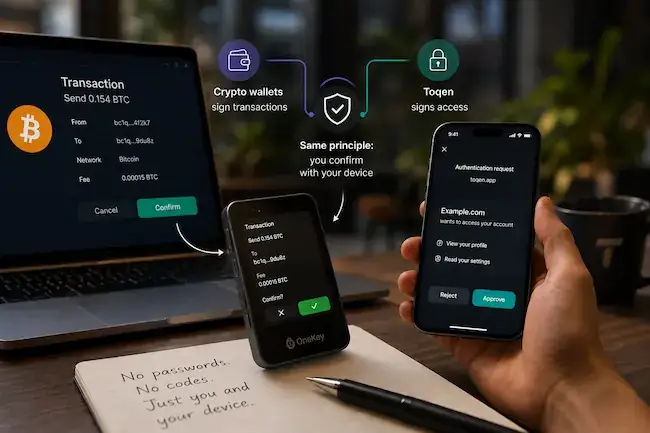
In both, the same principle applies: you do not send secrets, you confirm actions with your device.
How crypto actually works
Cryptocurrency is not stored in a wallet.
It is recorded on a network: a specific address has a specific balance.
To spend funds, you need to prove: “I am the owner of this address.”
This is done using a cryptographic key.
What a hardware crypto wallet does
It performs one critical function: it signs actions internally.
This is how it works:
- You want to send funds.
- Your computer prepares a transaction.
- The device shows the details.
- You press a button.
- The wallet signs the transaction.
- The transaction is sent to the network.
The key never leaves the device. Only the signature is shared.
A real device example
For example, OneKey is a hardware wallet that follows this exact model.
OneKeyIt is a separate device that:
- stores the key internally;
- shows what you are confirming;
- requires a physical action.
The logic is exactly the same as described above.
Why this works
The network does not check who you are. It checks whether the signature is valid.
If the signature is correct, the operation is accepted.
Now look at website access
The usual approach:
- password;
- code;
- sometimes SMS.
The problem is that all of this can be intercepted, tricked, or replaced.
The same idea applied to access
This is where Toqen.app comes in.
It applies the same principle used in crypto wallets to authentication.
Toqen.appHow it works in practice
- A website requests access.
- A QR code appears.
- You scan it with your phone.
- You see who is requesting access and what for.
- You confirm the request.
Access is granted.
What happens under the hood
The process mirrors crypto transactions:
- there is a request;
- there is a device;
- there is a signature.
Your phone signs the fact of your approval.
The key idea
Instead of entering a secret, you confirm an action with your device.
Why this changes the game
Nothing to steal
- no password;
- no code;
- nothing to intercept.
No remote confirmation
Even if a computer is compromised, actions cannot be confirmed without your device.
You see what is happening
Just like a hardware wallet, the real request is displayed and you make the decision.
Important note
The system is not magical.
If a person confirms blindly without checking the request, risks still exist.
However, the model changes: attacks become significantly harder because real user involvement is required.
One model for everything
You can now connect everything:
- a crypto wallet confirms money transfers;
- Toqen.app confirms access.
In both cases, there is a device, an action, and a signature.
The most accurate analogy
- a password is like giving your key to someone;
- a device signature is like opening the door yourself.
Final
The world is moving from sharing secrets to confirming actions.
Crypto wallets have already proven this model for money. The same logic is now being applied to access.
At this point, a phone is no longer just a gadget.
It becomes the device that says: “yes, this is really me.”