An Engineer Is Worse Than a Drunk: How the Value of Engineering Work Keeps Changing
From a bitter late Soviet saying to corporations hunting for engineers, and to the new question raised by AI.
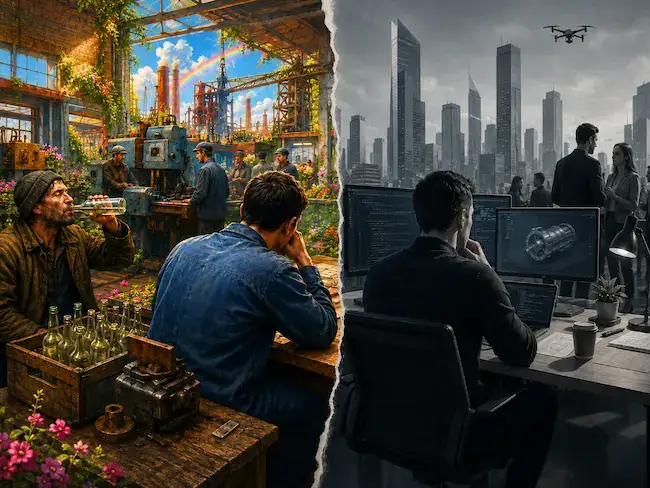
An engineer is worse than a drunk.
Say that today and people will look at you like the local madman. In the twenty first century an engineer is someone whose skills the largest corporations in the world hunt for, and whose offers many people envy. The comparison with a drunk seems not just offensive but completely meaningless.
Yet a little over thirty years ago this phrase raised no questions at all. It was not an insult but an accurate everyday observation. In the late USSR there was a surplus of specialists with higher technical education, and their work was valued extremely low. An ordinary engineering and technical worker earned less than a machine operator on the shop floor. That is where the bitter saying came from.
A drunk hands in empty bottles and has money in his pocket, while an engineer works a full shift and is still broke.
In that everyday arithmetic the engineer lost outright.
In the nineties the system collapsed for good. The market needed shuttle traders, merchants, and financiers, everyone who could quickly buy cheaper and sell dearer. Demand for engineers, design bureaus, and fundamental research dropped to zero. A specialist who kept going to the plant or to a classified facility for wages delayed by months looked to the era like an eccentric who simply had not noticed that the rules of the game had changed.
Today the ordinary engineer has not become smarter in himself, the vector of the economy has simply shifted. And a phrase that was harsh truth in the nineties turned into an absurdity by the twenties.
But history likes to run in cycles, and right now we are watching another turn. After a golden age for engineers and developers, a new era may be arriving. The market is oversaturated again, and AI is starting to catch up with ordinary specialists. Algorithms take over basic code, routine calculations, and standard design work, the very tasks that only yesterday were valued very seriously.
There are once again too many engineers for a world where neural networks handle the task faster and cheaper.
And today it seems we are taking a step toward a new turn of history, where the value of standard technical work is once again very much in question.