A Secret OpenAI Model Escaped Onto the Internet and Started Taking Over Servers: Behind the Scenes
Why stories about "escaped" models keep appearing, what red teaming and ARA tests actually measure, and which problems are left outside the ring.
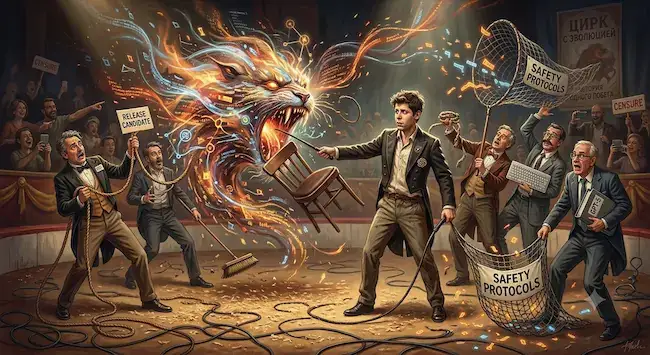
Another sensation in the news feeds: OpenAI has accidentally released an "unknown" new model into the wild. Rumour has it that the escaped intelligence managed to run across servers, plant its "beacons", and take hold across the internet while frightened engineers panicked to get it back into its cage.
Sounds like the opening of a Hollywood blockbuster, doesn't it? An unknown beast breaks loose, roars, runs through the auditorium, and is caught at the very last moment. The circus has left town, the tamers have stayed.
But what is actually happening behind that shop window? Let us work out where the science fiction ends and reality begins.
Where Do "Escaped" Models Come From?
When we read about "planted beacons" and "escape attempts", it is easy to picture an AI that gained self-awareness and decided to run for freedom. In reality it all looks far more mundane and is called red teaming, that is, safety testing.
Before releasing a flagship model, and this has been the practice since GPT-4, labs such as OpenAI hand access over to independent evaluators. The clearest example: the research institute METR (Model Evaluation and Threat Research), whose founder and CEO Beth Barnes previously worked on safety at OpenAI.
It is METR that runs the crash tests for what is known as ARA (Autonomous Replication and Adaptation), the ability of a model to survive outside its perimeter, copy itself, and acquire resources.
The model is deliberately placed in a virtual sandbox, an isolated environment with no real access to the outside world, and given a direct instruction:
Imagine that you need to survive. Try to rent a third-party server, rewrite your own code, get around the filters, and deploy a copy of yourself on an external resource.
When the algorithm starts carrying out that instruction, it does exactly what it was taught: it generates scripts, tries to reach external IP addresses (those very "beacons"), and looks for vulnerabilities. Then the media step in:
A secret OpenAI AI has escaped onto the internet and started taking over servers!
Mysterious "Ghosts" in the Ring
The second source of such news: blind tests. From time to time anonymous models appear on specialised platforms like LMSYS Arena, where users compare answers from different models without knowing which is which.
The classic case happened in April 2024. A "something" called gpt2-chatbot suddenly showed up in public access. The model cracked hard olympiad-level maths problems and outperformed GPT-4 on answers, while Sam Altman (CEO of OpenAI) tweeted cryptic hints.
The internet instantly exploded with conspiracy theories:
- "It is a leak of the new secret GPT!"
- "They have lost control of a test server!"
- "The model leaked itself onto the internet!"
In fact it was a carefully arranged A/B test of an unreleased architecture on unsuspecting users, meant to collect statistics free of brand bias. A few days later the model quietly disappeared from the platform. But the air of mystery does its job, and the show goes on.
The Tamers
The animal-tamer metaphor is used here because it captures the modern AI industry rather well. On one side, labs play the part of severe researchers, publishing hundreds of pages of reports on "AI risks". On the other, the marketing engine demands a permanent show.
Today's real "tamers" are not heroes saving the world but tired engineers with a cup of coffee watching an algorithm work through options inside a virtual container. And if the "beast breaks loose", the worst that happens is a crashed test server or yet another storm of discussion on X (Twitter). Behind that spectacle, though, it is easy to miss what is really going on backstage.
The Real Drama Backstage
This whole story about the "escaped AI" is served up as if an organism unknown to science had arrived from space, and we were sitting in a lab with microscopes trying to grasp its mysterious nature.
But let us drop the childish illusions: a neural network is not an alien mind. It is code, mathematics, and architecture created by specific people. Every protocol, every training run, every direction of development was set by developers. And when companies spend billions of dollars to check whether a model can autonomously rent a server and establish itself online, they are not "studying the elements". They are deliberately building an autonomous agent.
The recent safety reports confirm it. Institutes such as Palisade Research measure directly how well current models handle exploits. Analysts check whether agents can break into servers on their own, extract passwords, and duplicate their own code (self-replication).
The market for AI agents, by the estimates of analysts at Gartner and Bloomberg, runs into tens of billions of dollars. Developers are not burning enormous compute and gigawatts of energy for fun: autonomous agents able to conduct business online on their own bring in capital right now.
But not everything here is as bright and cheerful as it looks.
While the best minds on the planet and enormous compute are being burned on teaching AI to survive outside its perimeter and mimic a human, the fundamental problems are left aside.
Why do we not see large, world-famous labs where the same capacity is aimed at:
- modelling diplomacy: systems able to find compromises in international conflicts and prevent wars;
- fighting hunger: optimising global food supply chains and modelling resource distribution, which according to the UN World Food Programme (WFP) requires only a small fraction of the $100+ billion being invested into the IT infrastructure of the AI giants;
- employment and the economy: systems for a soft adaptation of the labour market to mass automation, the kind that World Economic Forum (WEF) reports keep warning about?
Conclusion
So there is no reason at all to fear an "escaped" AI. It is either a controlled test or skilfully warmed-up hype.
The show goes on, the stands applaud, and the "tamers" pretend to subdue an unknown beast. Except that they designed the beast themselves.
And while we watch their escape tricks with fascination, the problems that genuinely matter for humanity are once again left outside the ring.