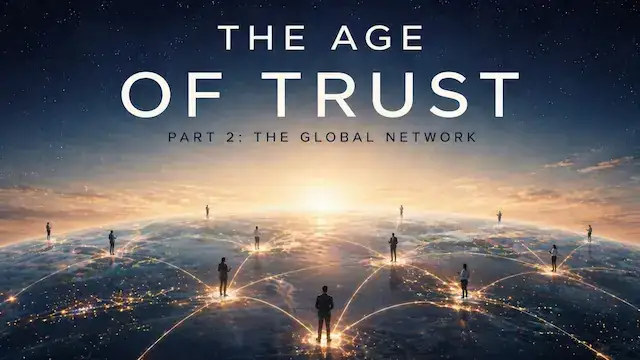
The Age of Trust, Part 2: The Global Network
A vision for a global trusted-contact network where people, specialists, and companies can be discovered through private trust paths.
In the first part, I wrote about a simple shift: in the AI era, knowledge is no longer the main scarce resource.
When information becomes available almost instantly, the real value moves toward problem solving, judgment, responsibility, and trust.
This second part is about a broader idea I have been thinking about: a global trusted-contact network for finding people, specialists, and companies through real trust paths.
Not just who is visible online, but who can actually be trusted in a specific context.
The Problem with Finding People Today
Finding the right person has become easier on the surface and harder in practice.
We have search engines, professional networks, social platforms, marketplaces, communities, chats, and recommendation feeds. It seems like everyone is reachable.
But when the decision really matters, visibility is not enough.
- who can be trusted as a specialist;
- who is reliable as a partner;
- who can be safely introduced to someone;
- who has real experience in a specific context;
- who should receive access, attention, money, or responsibility.
These questions are rarely answered by public profiles alone.
Public Signals Are Not Enough
The internet mostly evaluates people through public signals.
- followers;
- likes;
- reviews;
- ratings;
- badges;
- comments;
- public recommendations.
These signals can be useful, but they are too shallow for many important decisions.
Reviews can be manipulated. Ratings often miss context. Social profiles show packaging more than real interaction history. Public recommendations may reflect politeness, marketing, or social pressure.
Real trust usually lives somewhere else.
In private conversations, personal networks, previous work, shared experience, and quiet recommendations.
Real Recommendations Are Fragmented
The strongest recommendations are often not public.
They are scattered across private chats, calls, introductions, small communities, old projects, and personal memory.
When someone needs a reliable specialist, investor, founder, lawyer, designer, developer, consultant, or local contact, the process usually starts with a simple message.
Do you know someone reliable for this?
This works, but it works slowly, randomly, and only inside the networks that are immediately visible to us.
A lot of valuable trust already exists. It is just not structured.
A Global Trusted-Contact Network
The idea is a global trusted-contact network for finding people, specialists, and companies through private trust paths.
A person could add a rough location, areas of expertise, short profile information, and the kinds of contexts where they are open to interaction.
Other people could create or remove private trust connections with that person in specific contexts.
- I trust this person as a frontend engineer;
- I can recommend this person as a designer;
- I know this person as a reliable local contact;
- I can confirm this person’s experience with fundraising;
- I would route a security-related request through this person.
The result is not a public popularity score. It is a private network of contextual trust.
Private Trust Paths
The most important part of this idea is not the profile. It is the path.
When someone needs to reach a specialist, partner, investor, company, or local contact, the system would not only show public search results. It would help route the request through a private chain of trusted people.
The full chain would not be exposed.
- each person in the path can approve the request;
- each person can stop the request;
- the requester does not see the full chain;
- if the request stops, the requester does not see where it stopped;
- the target person receives only the request that passed through the trusted path.
This keeps the process human, private, and respectful.
A Simple Example
Imagine I need a reliable tax specialist in another country.
I can search online and find dozens of profiles. Some have reviews. Some have polished websites. Some have strong public content.
But the real question is different.
Who can confirm that this person is reliable for my specific situation?
In a trusted-contact network, I could see that there is a private trust path to a specialist.
Maybe I do not know the specialist directly. But someone I trust knows someone who worked with them. The system can route the request step by step without revealing the entire network.
If people along the path approve the request, the contact can happen. If someone decides it is not appropriate, the request simply stops.
Why the Network Must Be Private
A trust network becomes dangerous if it turns into a public map of personal relationships.
Public relationship graphs can create pressure, manipulation, unwanted exposure, social debt, and uncomfortable expectations.
That is why privacy is not an extra feature. It is part of the core design.
- the full chain should not be visible;
- private connections should remain private;
- people should be able to stop requests quietly;
- rejections should not become public signals;
- the system should reveal only what is needed for the next step.
The goal is to make discovery more honest and safer, not more socially aggressive.
Controlled Disclosure
The network should work through controlled disclosure.
A person should not need to reveal their full network, full history, full identity, or every reason behind a decision.
The system should provide only the minimum necessary signal for a specific action.
- there is a trusted path;
- the request can be passed forward;
- the context is relevant;
- the person is reachable through trusted connections;
- the request was accepted or stopped.
This is the same principle that I see as important in access systems: disclose only what is necessary for the action being performed.
This Is Not a Rating System
A global trusted-contact network should not reduce people to universal scores.
Trust is too contextual for that.
Someone may be excellent in one role and unsuitable for another. Reliable in one context and unknown in another. Strong in one country, industry, or type of work, and still unverified elsewhere.
The system should not answer the question “Is this person good?”
It should help answer: who can confirm this person for this specific request?
Where This Could Be Useful
This kind of network could be useful in many areas where trust matters more than visibility.
- hiring specialists;
- finding contractors;
- international relocation;
- local services;
- investment and fundraising;
- B2B partnerships;
- legal, tax, and financial introductions;
- professional communities;
- founder and investor discovery;
- private clubs and expert groups;
- human-to-agent and agent-to-agent access flows.
In each of these areas, the problem is not only finding someone. The harder problem is understanding whether interaction is appropriate and safe.
How This Connects to Toqen.app
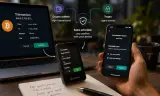
I am building Toqen.app as access-first authentication infrastructure designed for secure, real-time authorization.
Toqen.app solves a specific access problem: how to authorize a person quickly, securely, and with the minimum necessary amount of data.
A user opens a website, scans a QR code in the mobile app, confirms the request, and the service receives a verifiable authorization event.
The trusted-contact network is a broader idea, but it follows a similar principle.
For a specific action, the system should ask for and reveal only what is truly necessary.
Access and trust are different problems, but they are connected by the same direction: more precise digital interactions with less unnecessary exposure.
The Global Network
The global network I imagine is not a public social graph and not a popularity contest.
It is a private infrastructure layer for routing trust: from one person to another, from one company to another, from one context to another.
The internet has already made people searchable.
The next step is making trusted interaction easier, safer, and more precise.
That is the direction I see behind The Age of Trust.