AI and Vibe Coding: Good or Evil?
Why some companies take losses while others grow exponentially: a breakdown with examples from Shopify, Meta, Klarna, Duolingo, and others.
The term vibe coding was described by Andrej Karpathy, former director of AI at Tesla and a co-founder of OpenAI. He named an approach in which a person no longer writes code line by line, but works as an architect and a setter of tasks, handing 80 to 90 percent of the routine to AI agents like Cursor, Claude Code, or GitHub Copilot.
Practice has shown that vibe coding is a multiplier of a company's strategic thinking rather than a magic pill or a threat in itself.
Below is a breakdown, with examples, of how the adoption of AI and vibe coding played out in real companies across different industries.
1. Big Tech and the Technology Giants
Shopify
- Decision: they ran a refactoring of their processes, moved developers to vibe coding (Cursor, Copilot), and required a focus on product thinking instead of the number of lines written.
- 🟢 Result: a multiple increase in the number of new feature launches without mass layoffs, and almost double the output per engineer.
Meta
- Decision: they declared a year of efficiency, laid off tens of thousands of developers and managers, redirected the freed payroll into buying GPUs and infrastructure, and required the remaining teams to switch to AI tools.
- 🔴 Result: a drop in internal expertise in core products, burnout among the remaining senior engineers, and growing release risks.
Salesforce
- Decision: support headcount cut from 9,000 to 5,000 people through AI agents (Agentforce), with a hiring freeze for line programmers.
- 🔴 Result: higher margins on paper, alongside a sharp increase in load on the remaining architects, who have to fix the AI's mistakes by hand.
Alibaba and Tencent
alibabagroup.com tencent.com- Decision: quiet dismissals of rank-and-file developers through mandatory AI coding quotas and payroll cuts.
- 🔴 Result: falling motivation, degraded quality of internal systems, and lawsuits from employees (courts prohibit replacing people with AI).
2. Fintech, E-commerce, and Marketplaces
SoftBank
- Decision: the AI-nization program, teaching vibe coding and AI not only to the IT department but also to sales people, logistics staff, and marketers.
- 🟢 Result: routine work automated, marketing campaigns accelerated, and logistics optimized without cutting headcount.
Klarna
- Decision: they froze hiring and cut headcount from 5,500 to 3,400 people, officially announcing that developers and support were being replaced by AI.
- 🔴 Result: more system failures, lower service quality, and an admission of the mistake from CEO Sebastian Siemiatkowski, followed by a return to hiring.
Mercado Libre
- Decision: they rolled out vibe coding for more than 13,000 developers, redirecting the time freed from writing syntax toward security and architecture.
- 🟢 Result: code shipping accelerated by 50 to 60 percent, and the time needed to test a hypothesis dropped from months to a few days.
Payoneer
- Decision: they adopted vibe coding and AI assistants to automate routine integrations, tests, and anti-fraud scripts.
- 🟢 Result: exponential growth in transaction volume without inflating the engineering team, with system stability fully preserved.
Flippa
- Decision: they moved code evaluation, site audits, and traffic verification of the IT assets being sold onto AI tools.
- 🟢 Result: deals close several times faster, and a small team now handles volumes that used to require entire departments.
Kakao
- Decision: the AI Mileage program ($120 a month for every engineer to spend on vibe coding tools) and a rebuild of processes without layoffs.
- 🟢 Result: developer productivity up by 50 to 100 percent and fast launches of new services across the ecosystem.
3. EdTech, Content, and Publishing
Habr
- Decision: they introduced AI search and summarization and allowed authors to use AI to generate content and code.
- 🔴 Result: the platform filled up with low-quality generated texts, the engineering community pushed back with mass downvotes for articles written without understanding the subject, and moderation rules had to be tightened.
Chegg
- Decision: they tried to urgently replace their human expert base with AI generation and cut more than 40 percent of staff.
- 🔴 Result: the business collapsed, the content lost its uniqueness, more than 50 percent of users left, and the company's market value fell by more than 80 percent.
Duolingo
- Decision: they cut 10 percent of contractors, handing translation, localization, and content generation to AI tools.
- 🔴 Result: reputational damage from the drop in lesson quality (sterile content) and an overload on in-house engineers who had to fix the AI's mistakes.
Rakuten Kobo
- Decision: instead of people, they trusted AI algorithms with moderation, formatting, and quality assessment of incoming books and materials.
- 🔴 Result: the control system degraded. Without human context the algorithms started going blind: a wave of low-quality generated books flooded the platform, while valuable work by real authors was blocked in bulk because of false positives from AI detectors.
4. Contract Development, Freelance, and Non-tech Business
G2i
- Decision: they stopped hiring entry-level and mid-level developers and shifted the focus of client requests to AI.
- 🔴 Result: falling revenue in classic contract development and a forced repositioning toward finding architects for work with AI.
Alignerr
- Decision: they moved freelancers from writing code from scratch to a vibe coding model, assembling AI-produced code and labeling its errors.
- 🔴 Result: basic coding lost its value, and a specialist's worth shifted entirely toward auditing and validation.
EnFi and ZenBusiness
enfi.ai zenbusiness.com- Decision: they taught vibe coding (Cursor, Claude Code) to marketers, HR, and product managers.
- 🟢 Result: non-technical employees started assembling working services and dashboards themselves in a matter of hours, taking the load off the engineering department entirely.
The Bottom Line
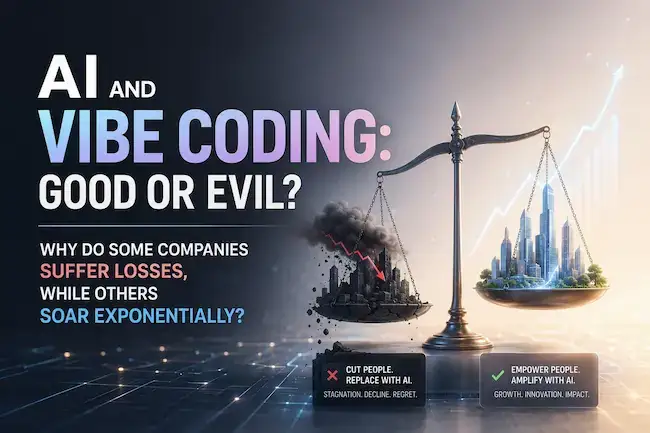
- Firing people and replacing them with AI and vibe coding to cut payroll means stagnation and decline: failures, product degradation, lost context and expertise, and the cost of hiring and training all over again.
- Keeping people and turning engineers into architects and non-technical staff into builders means geometric growth: hypotheses tested in hours, a multiple jump in shipped features and innovation, and products released far faster and better.
The winners are not the ones who saved on a developer's salary, but the ones who gave their people vibe coding as a superpower.
Which is how it usually goes: the winners are those who look for growth, not for savings.