Movies About Creative Thinking: Documentaries
There is no script here: real masters talking about their work.
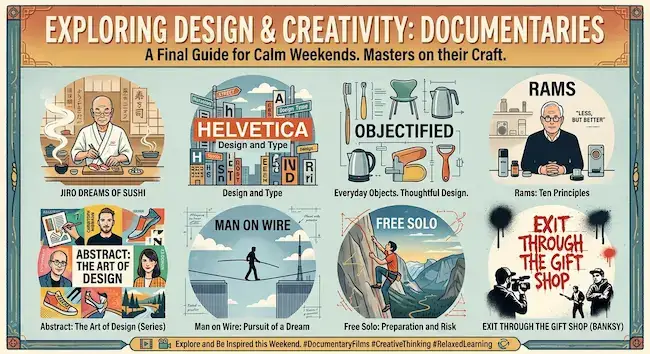
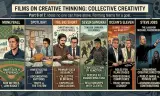
Part seven, the final one. There is no script here: real masters talking about their work.
The calmest part of the selection. Perfect for a day off, when you want something smart and free of nerves.
Jiro Dreams of Sushi (2011)
An eighty-five-year-old chef in a small place under the Tokyo subway, three Michelin stars, ten seats at the counter.
Daily improvement instead of reaching an ideal, the part suppliers and apprentices play in a master's result, succession between father and son, simplicity as the highest complexity.
Aftertaste: contemplative and very calm, with a mild hunger. Beautiful cinematography and music by Philip Glass, after which you want silence.
Helvetica (2007)
A feature-length film about one typeface and about why it is everywhere.
Neutrality as a stance, an argument between generations of designers, type and corporate identity, a city environment assembled out of letters.
Aftertaste: unexpectedly gripping for a film about a typeface, with a well-known side effect: for a week you read the signage instead of looking around.
Objectified (2009)
A follow-up by the same director, this time about industrial design and the things around us.
An object as someone's problem solved and frozen in place, mass production and consumption, sustainability and the lifespan of a thing, the invisible work of the designer.
Aftertaste: curious and slightly sobering. You start turning a toothbrush over in your hands and studying the kettle.
Rams (2018)
A portrait of Dieter Rams, author of the ten principles of good design, who at eighty-six regrets the profession he chose.
The principle of less but better, a master's doubts about his own field, the overproduction of things, a home as a continuation of a method.
Aftertaste: quiet, minimal, with music by Brian Eno and a shade of sadness. After watching, people usually want to throw something out.
Abstract: The Art of Design (2017-2019)
A series in which each episode is devoted to one designer: an illustrator, a shoe designer, a stage designer, an architect, a typographer.
Different working processes inside one profession, discipline against improvisation, the relationship with a client, the influence of a biography on a style.
Aftertaste: energising and very beautiful; the forty-minute episodes are easy to watch one at a time. The usual advice is to start with the Christoph Niemann and Es Devlin episodes.
Man on Wire (2008)
How a wire walker prepared his walk between the World Trade Center towers in 1974: reconnaissance, drawings, forged documents, rehearsals.
Years of preparation for a few minutes, obsession as an engine, a team gathered around someone else's dream, an act with no practical purpose.
Aftertaste: exhilarating, with vertigo and an unexpected sadness at the end. It plays like a heist film and is remembered as a story about loving your work.
Free Solo (2018)
A climb of El Capitan without ropes and, more importantly, the two years of preparation for it.
Breaking a route into sections and drilling them to automatism, risk as a parameter, the effect of observers on a performance, the people close to someone who has chosen this.
Aftertaste: extremely tense, with sweaty palms and euphoria afterwards. Many watch the finale through their fingers, and that is a normal reaction.
Exit Through the Gift Shop (2010)
Banksy's film about a man who filmed street artists and then declared himself an artist.
A method and its imitation, the mechanics of hype in the art market, the anonymity of the author, documentary form as a device.
Aftertaste: mocking, brazen, disorienting. The argument over whether it is staged is still going, and that is exactly why the film is so much fun to discuss.
That is the end of the series.
The whole series: